Evidence-based guide
What Is Life Logging? Examples, Benefits, and How to Start
Learn what life logging means, see practical examples, compare it with journaling, and start a useful personal record without tracking everything.
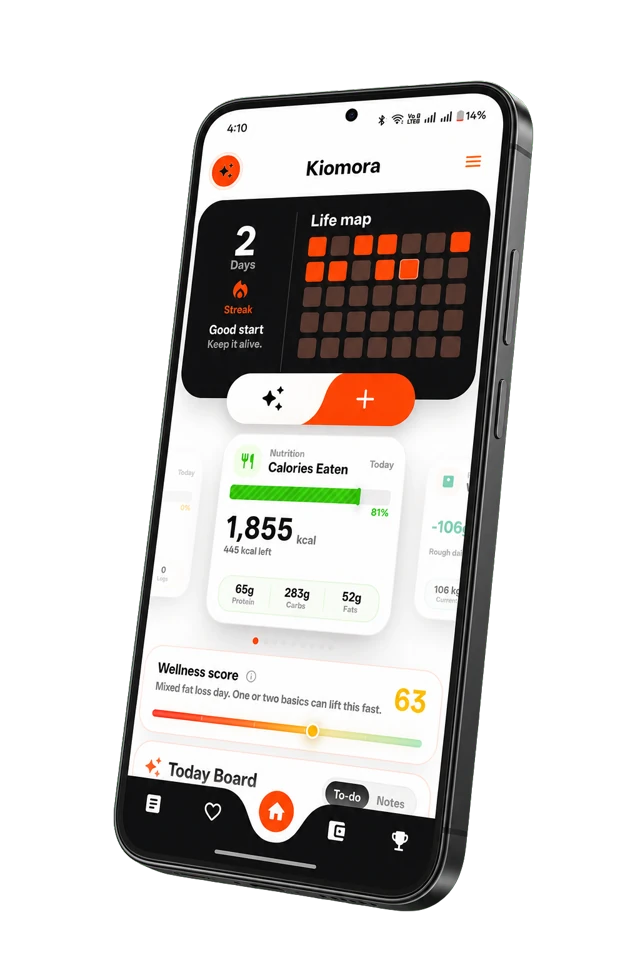
Kiomora for a useful record
Keep what matters
Capture selected daily context, review it, and return to the record without trying to track every minute.
Explore KiomoraEvery day contains more decisions, conversations, routines, and small moments than anyone can recall in full. By next Tuesday, much of today may already feel indistinct, reduced to a general impression and a few memorable details.
Life logging is one practical response: intentionally keeping selected details from daily life so they can be searched, reviewed, and understood later. It is closer to a curated personal record than a perfect memory. Every record is incomplete, and any summary remains limited by what was actually captured.
This guide explains the history, methods, benefits, limitations, and privacy tradeoffs of life logging, then shows how to start with a small routine you can realistically maintain. If you prefer a purpose-built workflow over a custom spreadsheet or database, the Kiomora life logging app guide shows how natural capture and reviewable logs fit together.
1. What Is Life Logging?
Life logging is the continuous, periodic, or event-based recording of selected personal data, including actions, experiences, measurements, moods, consumption, and context, with the goal of creating a record that can be searched or reviewed later. The term includes everything from handwritten diaries to wearable devices, but a sustainable practice usually begins with a much smaller promise: capture what may be useful later, then review it with context.
Unlike a traditional journal entry that might read "Today was a good day," a life log might capture that you slept 7 hours and 22 minutes, drank 3 cups of coffee, walked 8,400 steps, spent $34.50 on lunch, noted a headache at 4 PM, and read 40 pages before bed. Those entries can help you compare days or recover a detail later, but they remain incomplete observations rather than an objective portrait of your life.
Modern life logging typically falls into two categories:
- Passive logging: Data collected automatically by devices and sensors. Your Apple Watch tracking heart rate, your phone counting steps, your bank recording transactions - all without requiring any conscious effort from you.
- Active logging: Data you intentionally record. What you ate, how you felt, what you accomplished, who you talked to, what symptoms appeared. This is the contextual layer that gives passive data its meaning.
A useful modern system can place selected passive measurements beside active context while preserving clear consent, review, deletion, and privacy boundaries. The goal is not a complete recording of a life. It is a record small enough to maintain and specific enough to answer a future question.
The Evolution of Life Logging
2. History of Life Logging
The impulse to document daily life is as old as literacy itself. Life logging didn't begin with smartphones and fitness trackers - it began with ink, papyrus, and the fundamental human need to make sense of passing time.
Ancient Origins
One of the earliest known documents resembling a personal log is the Diary of Merer, an ancient Egyptian papyrus dating to approximately 2560 BCE. Merer, an inspector involved in the construction of the Great Pyramid of Giza, kept daily records of his team's activities - logging work shifts, resource transportation, and supply allocations. While administrative rather than introspective, it demonstrates the deep human instinct to record daily activity in structured form.
In the second century CE, Roman Emperor Marcus Aurelius wrote his Meditations - a collection of private philosophical reflections that function remarkably like a modern reflective journal. Though never intended for publication, the Meditations capture the daily intellectual and emotional landscape of one of history's most powerful leaders.
The Rise of the Personal Diary
The personal diary as we understand it emerged in the 17th century. Samuel Pepys, the English naval administrator, kept what is widely regarded as the most famous diary in the English language from 1660 to 1669. Pepys recorded everything: political events, the Great Plague and Great Fire of London, his finances, meals, theater visits, relationships, and health. His diary was a life log in every meaningful sense - a comprehensive, multi-dimensional record of daily existence, not merely a stream of emotional reflections.
Benjamin Franklin's Quantified Self
Perhaps the most direct ancestor of modern life logging is Benjamin Franklin's virtue tracking system, described in his Autobiography (circa 1771). At age 20, Franklin identified 13 personal virtues, including temperance, silence, order, and industry - and designed a pocket notebook with a grid chart to track his daily adherence to each one. Every evening, he would review his behavior and mark any "faults" with a black dot. His goal was to keep the chart as clean as possible across 13-week cycles, completing four full rotations per year.
Franklin's system is a remarkably sophisticated example of structured self-monitoring with periodic review - a practice that modern behavioral science has validated as one of the most effective tools for behavior change. He was, in essence, running a quantified self experiment 250 years before the term existed.
The Memex and the Digital Dream
The conceptual foundation for digital life logging was laid in 1945 when Vannevar Bush, the director of the U.S. Office of Scientific Research and Development, published his landmark essay "As We May Think" in The Atlantic. Bush described the "Memex" - a hypothetical desk-sized device that would store an individual's entire library of books, records, and communications on microfilm, allowing the user to retrieve any item quickly through "associative indexing." The Memex was never built, but its influence was seismic: it directly inspired the development of hypertext, the personal computer, and the World Wide Web itself.
Gordon Bell and MyLifeBits
The most ambitious attempt to realize Vannevar Bush's Memex vision was the MyLifeBits project, launched at Microsoft Research around 2001 by computer scientist Gordon Bell alongside researchers Jim Gemmell and Roger Lueder. Bell set out to digitize his entire life: he scanned every book, letter, memo, and photograph he had accumulated over decades, and recorded every email, web page visited, phone call, and meeting.
To capture daily experiences automatically, Bell wore the Microsoft SenseCam - a prototype wearable camera that hung around his neck and automatically captured photographs based on environmental triggers like changes in light, movement, and even the wearer's heart rate. The result was a massive personal database, built on SQL Server, that contained hundreds of thousands of items and represented perhaps the most complete digital record of a single human life ever assembled.
Bell eventually scaled back the project around 2007, acknowledging that the rise of smartphones was making custom lifelogging hardware obsolete. But MyLifeBits proved the concept: a complete, searchable personal memory was technically possible. Bell and Gemmell published their findings in the 2009 book Total Recall: How the E-Memory Change Will Change Everything.
3. The Quantified Self Movement
The cultural and philosophical framework for modern life logging crystallized in 2007 when Wired magazine editors Gary Wolf and Kevin Kelly coined the term "Quantified Self" and founded the movement under the motto: "Self-knowledge through numbers."
What began as a small gathering of roughly 30 technologists, biohackers, and data enthusiasts at Kevin Kelly's home in the San Francisco Bay Area grew into an international phenomenon. The movement organized around a simple format: "Show and Tell" meetups where members would present personal self-tracking projects and share the insights they had discovered in their own data.
The Quantified Self movement contributed several foundational ideas to the life logging space:
- N-of-1 experiments: The idea that individuals can conduct rigorous, personalized experiments on themselves to discover what works for their unique biology, psychology, and lifestyle - rather than relying solely on population-level averages from clinical studies.
- Personal science: The elevation of self-tracking from hobby to legitimate methodology. QS advocates argued that personal data, when collected consistently and analyzed honestly, constitutes a valid form of scientific inquiry.
- Tool agnosticism: The movement never prescribed specific tools. Members tracked with spreadsheets, wearables, custom-built apps, paper notebooks, and everything in between. The focus was always on the question being asked, not the technology being used.
The QS community hosted annual conferences - QS Global and QS Europe - that attracted researchers, clinicians, and product designers alongside self-trackers. The movement played a direct role in shaping the consumer wearable industry and influencing the design of products like Fitbit, the Apple Watch, and the Oura Ring.
The Quantified Self Loop
4. Why Humans Track Their Lives
The urge to record, measure, and reflect on daily experience isn't a quirk of the digital age - it's a deeply embedded cognitive behavior. There are several psychological and neurological reasons why self-tracking is so compelling:
The Observer Effect
In physics, the observer effect describes how the act of measurement changes the thing being measured. The same principle applies to human behavior. Research in behavioral psychology has consistently demonstrated that the mere act of monitoring a behavior changes that behavior. When you start tracking how much water you drink, you drink more water. When you record your spending, you spend less. This phenomenon - sometimes called "reactivity to self-monitoring" - is one of the most robust findings in behavioral science.
Prospective Memory and the "Forgetting Curve"
German psychologist Hermann Ebbinghaus demonstrated that recall of newly learned material generally declines over time. His experiments do not provide a universal percentage for everyday autobiographical memory, but the broader lesson is useful: a timely record can preserve details that later recollection may lose or reshape.
Pattern Recognition and Meaning-Making
People naturally search for patterns and narratives in experience. A life log can preserve dates and context that memory may omit, but the record still needs careful interpretation. A headache diary, for example, may show that several headaches occurred after poor sleep or afternoon coffee. That association can support a question for a qualified professional; it does not prove a trigger or cause.
5. Benefits of Life Logging
The benefits of systematic self-tracking extend across physical health, mental well-being, financial awareness, and personal productivity. Here are the major evidence-backed advantages:
Physical Health Optimization
A large body of research published in PubMed and the National Institutes of Health (NIH) supports the effectiveness of self-monitoring for health behavior change. Studies on dietary self-monitoring consistently find a dose-response relationship: participants who record their food intake more frequently lose significantly more weight than those who track sporadically. The research suggests that the key factor is not the recording medium (paper vs. app) but the consistency of the practice itself.
A personal log can help someone preserve possible associations between foods and symptoms, sleep and next-day energy, or movement and mood. These observations may help prepare a better conversation with a qualified professional, but they should not be treated as proven personal health triggers or as a replacement for medical advice.
Mental Health and Emotional Awareness
Psychologist James W. Pennebaker of the University of Texas at Austin has published decades of research on the health benefits of expressive writing. His foundational studies, beginning in the 1980s, found that participants who wrote about stressful or traumatic experiences for 15 - 20 minutes per day over 3 - 5 days showed measurable improvements in both physical and psychological health - including fewer doctor visits, reduced anxiety, and enhanced immune function. Later research identified the mechanism: the benefits come not from emotional venting, but from narrative construction - the cognitive process of organizing fragmented emotional experiences into a coherent story.
Life logging extends this principle beyond isolated writing exercises into a daily practice. By regularly externalizing your thoughts, moods, and experiences, you create ongoing opportunities for the kind of narrative construction that Pennebaker's research links to improved well-being.
Financial Clarity
Tracking daily expenses - even informally - produces the same observer effect that improves health behaviors. When you know that every purchase will be recorded, impulse spending decreases naturally. Over time, expense logs reveal chronic spending patterns (that daily coffee order, subscription creep, weekend retail therapy) that are easy to overlook in the moment but compound into significant financial impact over months and years.
Productivity and Time Awareness
Logging how you spend your time creates an objective record that often conflicts sharply with subjective perception. Most people dramatically overestimate the hours they spend on productive work and underestimate time lost to context-switching, social media, and low-value tasks. A time log provides the unvarnished truth, enabling you to make informed decisions about where to invest your most limited resource.
6. Risks and Limitations
Life logging is not without its challenges and potential downsides. An honest assessment of the practice requires acknowledging these limitations:
Survey Fatigue and Tracking Burnout
The single greatest threat to any life logging practice is abandonment due to friction. Research on self-monitoring adherence consistently shows that tracking frequency declines over time, often precipitously. When a logging system requires too many taps, too many decisions, or too much cognitive effort, users burn out - typically within 2 - 4 weeks. The irony is that the people who need self-tracking the most (those with chaotic, unstructured lives) are the least likely to maintain rigid, structured logging systems.
Data Anxiety and Obsessive Tracking
For some individuals, the constant measurement of health metrics, mood scores, and productivity levels can become a source of anxiety rather than insight. When every meal must be logged and every sleep score scrutinized, the tracking tool shifts from servant to master. Clinicians have raised concerns about the potential for orthorexic tendencies in obsessive self-trackers - a fixation on data optimization that paradoxically degrades the quality of life it is supposed to improve.
Privacy and Data Security
Life logs contain some of the most intimate data a person can generate: health conditions, emotional states, financial transactions, daily routines, and location history. Under regulations like the EU's General Data Protection Regulation (GDPR), health and biometric data are classified as "special category data" requiring the highest levels of protection and explicit consent. A breach of a life logging database would expose a far more comprehensive portrait of an individual than any single-domain data breach (like a stolen credit card number or email password) ever could.
This makes the choice of life logging tool a significant privacy decision. Users should evaluate: Where is data stored? Is it encrypted? Is it shared with third parties? Can it be deleted permanently? These questions are not theoretical - they are fundamental to the long-term safety of maintaining a digital record of your life.
The Interpretation Gap
Raw data without analysis is just noise. Many life loggers accumulate impressive databases but never develop the analytical habits to extract insights from them. A spreadsheet with 365 days of mood scores is only valuable if you periodically review it, look for trends, and test hypotheses. Without this "analysis loop," life logging degenerates into a data hoarding exercise with no actionable output.
7. How AI Is Changing Life Logging
The fundamental tension of life logging has always been this: the more data you capture, the more valuable the archive becomes - but the more effort it takes to maintain, the less likely you are to keep doing it. For decades, this tradeoff was intractable. You either accepted high friction and got rich data, or you accepted low friction and got sparse, shallow data.
Artificial intelligence has broken this tradeoff.
Modern natural language processing (NLP) and large language models can now parse unstructured text and speech with remarkable accuracy. This means that instead of tapping through rigid menus, selecting categories from dropdown lists, and entering numbers into form fields, you can simply describe your day in plain language - and let the AI do the structuring for you.
Consider the difference:
Traditional tracking: Open food app → Search "chicken salad" → Select portion size → Confirm macros → Open water app → Enter "3 glasses" → Open mood app → Select "7/10" → Open exercise app → Log "30 min walk"
AI-powered tracking: "Had a chicken salad for lunch, drank 3 glasses of water, went for a 30-minute walk, feeling pretty good today - about a 7."
The first approach requires four separate apps and roughly 25 interactions. The second requires one app and one sentence. The information captured is identical. The friction is reduced by an order of magnitude.
AI-powered life logging tools like Kiomora take this further by helping turn natural entries into reviewable logs. Saved food, activity, sleep, notes, and expense entries can then be revisited through timelines, daily views, and saved-log questions without presenting an automated diagnosis or causal explanation.
Voice logging adds another dimension. With a voice journal, you can dictate your daily log while driving, cooking, or lying in bed - further eliminating the barriers between experience and record. The AI transcribes, parses, and organizes your spoken words exactly as it would handle typed text.
Modern AI Life Logging Workflow
Experience AI Life Logging
Prefer lower-friction tracking? Kiomora Plus uses SuperLog to suggest structured cards from a natural update. You review and edit those suggestions before anything is saved.
8. Life Logging vs Journaling
Life logging and journaling are often conflated, but they serve different purposes and operate on different principles. Understanding the distinction helps you choose the right practice - or combine both intelligently.
- Journaling is primarily a narrative and emotional practice. The focus is on self-expression, reflection, and processing feelings. A journal entry might explore why a conversation upset you, what a dream might have meant, or how you're feeling about a major life decision. The output is qualitative: paragraphs of unstructured prose.
- Life logging is primarily a data and pattern practice. The focus is on recording objective facts and measurable details. A life log entry records what happened, when, how much, and how it measured. The output is quantitative: structured data points that can be charted, searched, and correlated.
Neither approach is superior. Many people benefit most from a hybrid approach: using structured life logging for the objective record and layering occasional journal-style reflections on top for emotional processing. The strongest personal tracking systems are those that welcome both a mood score of "6/10" and a paragraph explaining why.
Journaling has deep roots in therapeutic practice. As discussed in Section 5, James Pennebaker's research demonstrates that the narrative construction involved in expressive writing produces measurable health benefits. Life logging captures the raw material - the facts, metrics, and events - that makes that narrative construction more grounded and less prone to the distortions of selective memory.
9. Life Logging vs Habit Tracking
Habit tracking is a subset of life logging with a very specific focus: monitoring the consistency of predefined daily behaviors (e.g., "Did I meditate today? Did I drink 8 glasses of water? Did I read for 30 minutes?"). Apps like Daylio and template-based systems in tools like Notion have made habit tracking extremely popular.
The key differences:
- Habit tracking is binary and behavior-focused. You define habits in advance, and each day you check them off or don't. The data is narrow but highly structured.
- Life logging is open-ended and experience-focused. You record whatever happened - whether or not it fits a predefined category. The data is broad, contextual, and often messy.
Habit trackers work well when you already know exactly what behaviors you want to maintain. Life logging works better when you're exploring - when you want to discover which behaviors, conditions, and patterns actually matter to your well-being, rather than assuming you already know.
A practical example: A habit tracker can tell you that you meditated 22 out of 30 days last month. A life log can tell you that on the days you meditated, your afternoon focus scores averaged 15% higher and your evening irritability ratings were 30% lower. The habit tracker tracks the input. The life log reveals the output.
10. Best Life Logging Tools Today
The life logging ecosystem in 2026 spans wearable hardware, mobile apps, and hybrid platforms. Here are the major categories and notable tools:
Wearable Biometric Trackers
- Apple Watch / Apple Health: The most widely adopted health wearable ecosystem. Tracks heart rate, blood oxygen, sleep stages, steps, workouts, noise levels, and menstrual cycles. Apple Health acts as a centralized data repository that aggregates data from hundreds of third-party apps and devices.
- Oura Ring: A discreet ring-form wearable focused on sleep quality, heart rate variability (HRV), body temperature trends, and recovery readiness. Particularly popular among QS practitioners for its unobtrusive form factor and detailed sleep staging.
- Fitbit: One of the original consumer activity trackers, now part of Google. Offers comprehensive daily activity, exercise, and sleep tracking with a strong social/community layer.
Mood and Journal Apps
- Day One: A premium journaling app with rich media support (photos, videos, audio, weather, location), end-to-end encryption, and powerful search. Best for people who primarily want a narrative journal with some life-logging capabilities.
- Daylio: A popular micro-journal and mood tracker that uses icon-based input to eliminate writing fully. You select a mood level and tap activity icons. Best for people who want minimal-friction daily mood tracking.
AI-Powered Life Logging
- Kiomora: A modern AI life tracker for people who want a less rigid daily record. You can type, speak, or add a photo in SuperLog, then review suggested logs before saving meals, activity, sleep, notes, expenses, mood, habits, or progress. It is a practical option when you want everyday context in one place without pretending to record everything.
Choosing the Right Tool
The best life logging tool is the one you will actually use consistently. Research on self-monitoring adherence overwhelmingly supports this principle: the method that reduces friction to the lowest possible level for your lifestyle will produce the richest, most useful data over time. A complex system used for 5 days is infinitely less valuable than a simple system used for 5 months.
11. How To Start Life Logging
If the previous ten sections have convinced you that life logging is worth pursuing, here is a practical, burnout-resistant framework for getting started:
Step 1: Define Your Question
Don't start by choosing a tool. Start by asking a question. What do you want to understand about your life? Examples:
- "Why do I feel exhausted every Wednesday afternoon?"
- "Is my anxiety actually getting worse, or does it just feel that way?"
- "Where does my money actually go each month?"
- "Does exercise genuinely improve my mood, or is that just something I believe?"
A clear question gives your logging purpose and direction. It prevents the aimless data accumulation that leads to abandonment.
Step 2: Choose 3 - 5 Core Metrics
Resist the temptation to track everything on day one. Select 3 to 5 data points that directly relate to your question. For example, if your question is about energy levels, you might track: sleep duration, caffeine intake, exercise (yes/no and type), energy rating (1 - 10), and main meals.
Step 3: Establish a One-Minute Ritual
The logging habit itself must be frictionless. Anchor it to an existing habit - like right after brushing your teeth at night - and limit it to 60 seconds. With an AI-powered daily log app, this can be as simple as typing or speaking one or two sentences: "Slept 6 hours, two coffees, skipped the gym, energy was about a 4 by 3 PM." That's it. No menus. No checkboxes. No categories.
Step 4: Review Weekly
Data without review can become digital clutter. Set a short weekly appointment to scan your entries and note what repeated. A few weeks may reveal useful questions or missing context, but there is no universal amount of data that guarantees a reliable pattern or insight.
Step 5: Iterate, Don't Expand
After your first month, refine rather than expand. Drop metrics that aren't producing useful insights. Add one new metric that addresses a follow-up question. The goal is a lean, sustainable logging practice - not a comprehensive surveillance operation on your own life.
12. The Future of Personal Memory
The trajectory of life logging points toward a future where maintaining a comprehensive personal archive becomes nearly low-friction - and nearly universal.
Ambient Logging
As AI models become more capable, the boundary between "passive" and "active" logging will blur. Future life logging tools will increasingly be able to infer context from ambient signals: your calendar, location, communication patterns, wearable data, and even environmental factors like weather and air quality. The user's role will shift from "data entry clerk" to "data reviewer" - confirming and correcting an AI-generated daily summary rather than creating one from scratch.
Personal Knowledge Graphs
The next evolution beyond flat logs and time-series charts is the personal knowledge graph - a web of interconnected entities (people, places, habits, symptoms, goals, events) that maps the relationships between every element of your life. Imagine asking your life log: "Show me every time I had a headache within 48 hours of eating at that Thai restaurant" or "What activities did I do in the weeks when my mood was consistently above 7?" This kind of relational querying requires structured data, consistent logging, and increasingly sophisticated AI - all of which are rapidly maturing.
Digital Legacy and Memory Preservation
Gordon Bell's MyLifeBits project raised a question that remains unanswered: what happens to your life log after you die? As digital life archives become richer and more complete, they may evolve into a new form of personal legacy - a "digital memoir" that preserves not just photographs and documents, but the daily texture of a lived life. For future generations, searching a grandparent's life log may provide a deeper connection to the past than any photo album or handwritten letter ever could.
13. Frequently Asked Questions
What is life logging in simple terms?
Life logging is the practice of recording details about your daily life - what you eat, how you sleep, how you feel, what you spend, and what you do - in a systematic way so you can look back, find patterns, and make better decisions. It's like keeping a diary, but with structured data you can actually search and analyze.
Is life logging the same as journaling?
Not exactly. Journaling is primarily about self-expression and emotional reflection - writing paragraphs about your thoughts and feelings. Life logging is about capturing structured, measurable data: what happened, when, and how much. Many people combine both practices for a richer record.
What kind of data do life loggers typically track?
Common categories include: sleep duration and quality, food and water intake, exercise and physical activity, mood and energy levels, symptoms and health markers, daily spending, productivity and task completion, social interactions, and medications or supplements. The specific data depends fully on the individual's goals and questions.
How much time does life logging take each day?
With modern AI-powered tools, as little as 60 seconds. A single typed or spoken sentence summarizing key facts about your day can be automatically parsed into structured data. Traditional methods (manual apps, spreadsheets) may require 5 - 15 minutes depending on complexity.
What are the benefits of tracking your daily life?
Possible benefits include a clearer record of routines, spending, memorable events, and questions worth revisiting. Outcomes vary by person and by tracking method. Tracking can also create pressure or false confidence, so keep the practice small and stop if it becomes unhelpful.
Is life logging safe? What about privacy?
Life log data is deeply personal, so privacy is a legitimate concern. Look for tools that store data locally on your device or use end-to-end encryption. Under regulations like GDPR, health data requires the highest level of protection. Always check a tool's privacy policy before trusting it with intimate personal data.
Can life logging help with mental health?
Yes. Research by psychologist James Pennebaker shows that structured writing about personal experiences can reduce anxiety, improve immune function, and support emotional processing. Mood tracking specifically helps people identify triggers and patterns that contribute to anxiety and depression - information that is valuable both for personal awareness and for conversations with mental health professionals.
What is the Quantified Self movement?
The Quantified Self (QS) is a community and philosophy founded in 2007 by Gary Wolf and Kevin Kelly, centered on the idea of "self-knowledge through numbers." Members use personal tracking technologies to collect data about their lives, then share discoveries through meetups and conferences. The movement helped popularize wearable fitness trackers and health apps.
What was the MyLifeBits project?
MyLifeBits was a research project at Microsoft Research (circa 2001 - 2007) led by Gordon Bell. Bell attempted to digitize his entire life - scanning every document, recording every phone call, and wearing a camera to capture daily experiences. The project demonstrated that a comprehensive digital personal memory is technically possible, and inspired much of the modern life logging ecosystem.
How do I choose the best life logging app?
Prioritize low friction above all else. The best tool is the one you will use consistently for months, not the one with the most features. Look for: minimal daily input time, support for the data types you care about, useful visualizations and insights, strong privacy practices, and cross-device accessibility. AI-powered tools that accept natural language input significantly reduce friction compared to traditional form-based trackers.
What is the difference between passive and active life logging?
Passive logging is data collected automatically by devices (steps, heart rate, sleep, location). Active logging is data you intentionally record (meals, mood, symptoms, notes). The most complete life log combines both: passive biometric streams provide the objective backdrop, while active entries supply the contextual meaning that makes the data interpretable.
How long should I try life logging before seeing results?
Most people begin noticing patterns within 2 - 4 weeks of consistent daily logging. Meaningful, actionable insights - like identifying a specific food trigger or recognizing a weekly mood cycle - typically emerge after 6 - 8 weeks. The observer effect (behavior change simply from tracking) often begins immediately.
Can I start life logging with just a notebook?
Absolutely. Benjamin Franklin tracked his 13 virtues with a pocket notebook and a grid chart in the 1700s. A paper system works well for simple tracking. The limitation is searchability and analysis - digital tools excel at revealing patterns across large datasets that would be impractical to analyze by hand.
What is the future of life logging?
The field is moving toward ambient, AI-driven logging where your daily record is largely generated automatically from contextual signals (calendar events, wearable data, location, communication patterns), with the user simply reviewing and confirming a daily summary. Personal knowledge graphs - searchable webs of interconnected life data - may replace flat timelines as the primary interface for accessing personal memories.
Conclusion
Life logging is not a technology trend. It is a fundamental human practice - one that connects Benjamin Franklin's pocket virtue chart to Gordon Bell's SQL database to the smartphone in your pocket right now. The tools have changed enormously. The core impulse has not: we record our lives because doing so helps us understand them, improve them, and remember them.
The biggest barrier is often friction. New capture and retrieval tools can make a personal record easier to maintain, but the right amount of tracking and its value differ from person to person. A small experiment is more useful than assuming one system will work for everyone.
If you're ready to begin, start with a single daily entry. Don't optimize. Don't overthink. Just capture today - and let your future self thank you for it.
Ready to build your searchable memory?
Kiomora lets you capture one natural update by text, voice, or photo, then review the suggestions that belong in your daily record. Keep it light: save what you will want to revisit.
Try Kiomora Free →Common questions
Practical answers before you begin
- What is life logging in simple terms?
- Life logging means keeping a personal record of selected daily events, observations, and routines. It can be as small as a few notes about sleep, meals, spending, mood, or a memorable moment.
- How do I start life logging without burning out?
- Start with one reason and one low-friction habit: a short daily note, a voice update, or a weekly recap. Do not try to capture everything; consistency comes from recording only what you expect to revisit.
- What are some examples of life logging?
- Examples include a short daily note, sleep and energy entries, meal or movement records, expenses with context, photos tied to events, habit history, and memorable moments.
- Is life logging the same as journaling?
- Not exactly. Journaling usually centers on narrative and reflection. Life logging can combine narrative with structured events, measurements, media, and routines. Many people use both approaches in one personal record.
Don't forget to try Kiomora
See more thanone detail
Keep the useful parts of each day in one record you can return to.
Explore Kiomora