Evidence-based guide
Life Analytics: How to Review Your Day Without More Dashboards
A practical guide to turning scattered daily notes and trackers into useful context without letting scores or AI guesses tell you what your life means.
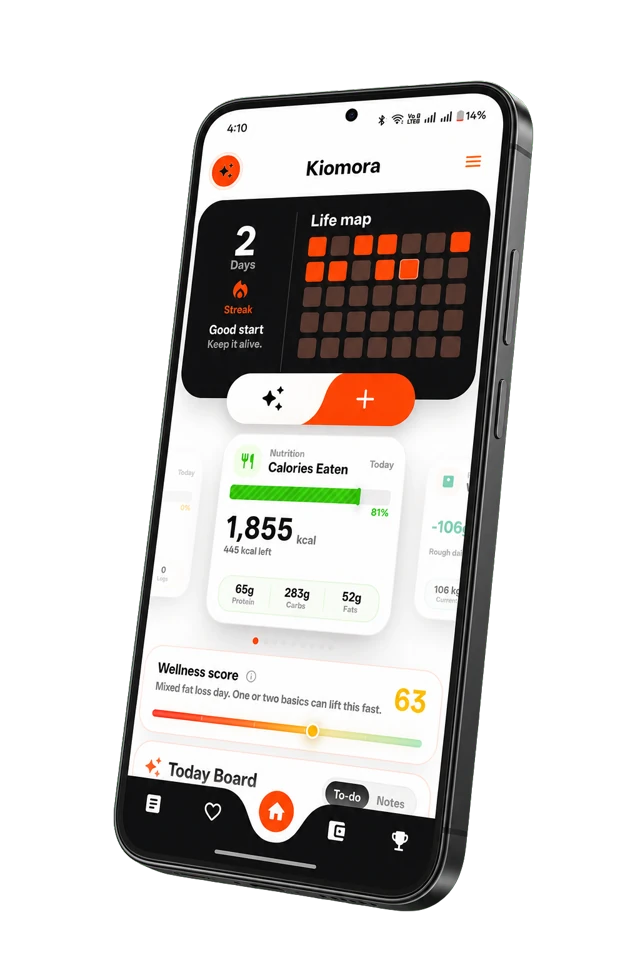
Kiomora for daily context
Your life, connected
Keep habits, wellness, spending, notes, and memories together so the details stay useful later.
Explore KiomoraDisclosure: We build Kiomora. "Life analytics" is our name for a careful personal review practice, not an established clinical discipline.
You wake up, reach for your phone, and open the app connected to the ring on your finger.
The screen glows with a pristine, algorithmic certainty. The ring has been tracking you all night. It has measured the microscopic variations in your heart rate, the slight fluctuations in your body temperature, and the restless shifting of your limbs. It has run these biometrics through a proprietary algorithm and generated a single, two-digit number.
Sleep Score: 98. Optimal Recovery.
You stare at the bright green circle on the screen. According to the database, you are closely rested. According to the algorithm, you are primed for a day of peak cognitive performance.
But as you sit on the edge of the bed, staring blankly at the wall, you feel a deep, hollow, and unexplainable exhaustion. It is the kind of exhaustion that seems to exist beneath your bones - a cognitive fatigue that makes the prospect of opening your email inbox feel like a physical weight.
You look back at the screen. Optimal Recovery.
This is the uncanny valley of modern health tracking. It is the creeping, quiet dissonance that occurs when the accurate digital map of your life completely contradicts the actual territory of your lived experience. In that moment on the edge of the bed, you are forced to make a bizarre psychological choice: do you trust the sophisticated biometric sensor on your finger, or do you trust your own body?
Increasingly, we have been conditioned to trust the sensor.
We live in the most meticulously documented era in human history. We possess the technological capability to record every heartbeat, every step, every geographic movement, and every fleeting thought. The premise behind this mass self-surveillance was simple and deeply seductive: if we could just capture enough data, the truth of our lives would inevitably reveal itself.
We were wrong.
We now collect a great deal of personal data, yet many of us still struggle to explain our own patterns. Tracking creates a record, but a record is not the same as understanding.
We have mistaken the ledger for the life.
But the era of blind accumulation is drawing to a close. We are standing at the precipice of a major change in personal computing. It is a shift away from the passive, automated capture of what happened, toward the active, deliberate comprehension of why it keeps happening.
We are entering the era of Life Analytics.
The Three Eras of Personal Computing
Humanity’s relationship with personal data has evolved in distinct, architectural eras. Each era was defined by a specific technological bottleneck that had to be solved before we could progress to the next.
Era 1: Capture (The Nervous System)
The first twenty years of the twenty-first century were dedicated fully to solving friction. The industry built the digital equivalent of a nervous system - placing accelerometers in our pockets and optical heart rate monitors on our wrists. But a nervous system cannot think. It can only report. The Era of Capture successfully digitized human behavior, but left us drowning in a sea of unstructured, isolated integers.
Era 2: Retrieval (The Memory Bank)
As personal data expanded, recall became a practical bottleneck. Search systems and language models made it easier to retrieve semantically related notes, creating what we call searchable memory. Retrieval can reduce scrolling, but it remains incomplete and error-prone. Finding a relevant entry is not the same as understanding what caused an outcome.
Era 3: Understanding (The Prefrontal Cortex)
We have solved Capture. We have solved Retrieval. Yet, we are still burned out and confused by our own behavior. We possess the sensory input and the historical archives, but we lack the executive function. The bottleneck is no longer friction or recall. The bottleneck is epistemology: how do we actually know what is true about ourselves?
This is the domain of Life Analytics. It is the discipline of taking the raw integers of Capture and the indexed archives of Retrieval, and subjecting them to a rigorous, interpretive engine.
But before we can build the third era, we must first confront the major failures of the tools we are currently using.
The Death of the Dashboard
If you look at the home screen of a modern smartphone, you will see the app graveyard of the fractured self.
You have Strava for movement, MyFitnessPal for fuel, Day One for thoughts, Apple Health for your heart, and ScreenTime for focus. You possess fourteen pristine, highly optimized databases, yet you are completely blind. Your sleep tracker does not know about the passive-aggressive email you received; your calendar does not know you skipped lunch.
Because our tools operate in isolation, they treat us not as complex, integrated human beings, but as a series of disconnected metrics. This vacuum of meaning birthed two deeply destructive paradigms that dominate the industry today.
The Dashboard Autopsy
When a system possesses data but lacks context, it defaults to the simplest possible narrative: the score.
We must state this plainly: a dashboard is an autopsy of yesterday. When you open a health app and see that your recovery is down 40%, you are looking at a post-mortem. The dashboard is merely confirming a physical reality your body has already experienced. It gives you facts, but it resolutely refuses to give you decisions.
Dashboards rely on the philosophical assumption that humans are like supply chains - that we can be lean-optimized by simply staring at the right dials. But staring at a red "Poor Recovery" circle does not give you the power to change your life; it only gives you the power to feel guilty about it. Millions of people stare at their tracking scores every morning and remain completely paralyzed. They watch the line graph of their recovery trend downward, and they watch their resting heart rate trend upward. They know they are burning out. But because the dashboard cannot synthesize why the burnout is happening, the user is left to blindly guess at the solution.
Algorithmic Gaslighting
Recognizing the paralysis of the static dashboard, the industry recently bolted Large Language Models onto text logs, claiming they had built "AI Life Coaches."
This is arguably more dangerous than the dashboard.
When someone asks an AI journal, "Why do I feel so anxious?" the model may generate a fluent explanation from a small set of nearby entries. It might mention exercise, sleep, or a calendar event even when the record cannot support that conclusion. The safe response is to retrieve the relevant entries, identify missing context, and keep possible explanations framed as questions.
This is Algorithmic Gaslighting. When we outsource our self-reflection to systems that lack evidential discipline, we allow a probabilistic text generator to rewrite the narrative of our own lives with a highly fluent lie.
We reached the breaking point of this Understanding Gap. The realization swept through the architecture: the failure was not technical; it was epistemological. We had to stop treating the human mind like an inventory system. We had to invent Life Analytics.
Defining Life Analytics: The Reintegration
Life Analytics is the architectural reintegration of the human being. It is a rigorous, distinct technological discipline designed to cure the blindness of the fractured self, built upon three foundational pillars.
Pillar 1: Evidential Discipline
A careful life-review system should avoid presenting causality as fact. It can place a subjective note beside the other information a person chose to record, then help them inspect dates and context. Biometric or calendar data can add context, but neither should be treated as a biological explanation or diagnosis.
Pillar 2: Cross-Domain Synthesis
An action becomes easier to understand when it keeps its context. A useful life record can place sleep, activity, calendar events, and personal notes on the same timeline without pretending that one caused another.
Pillar 3: The Socratic Machine
For two decades, software has been designed to be omniscient. Life Analytics introduces the concept of Epistemic Humility. When the system finds an anomaly but cannot find the biophysical or digital cause, it does not guess. It pauses. And then, it asks you. It becomes a Socratic Machine, asking: "I see the biophysical stress spike. But there is a missing variable. What happened in the room at 2:15 PM?"
The Architecture in Motion
What does Life Analytics actually look like? What would you actually see? How does a system of cross-domain synthesis differ from the dashboards and chatbots we use today?
Let us look at the architecture in motion across four distinct human realities.
1. The Founder Burnout Loop
The Scenario: A startup founder is working 70-hour weeks and waking up exhausted.
Traditional Dashboard (Apple Health/Oura): Shows a recovery score of 30. Turns red. Subtly blames the founder for poor sleep hygiene and tells them to "prioritize rest."
Generic AI (ChatGPT): Reads the founder's frustrated journal entries and suggests "implementing a morning mindfulness routine."
The Life Analytics Synthesis:
- Biophysical: Poor HRV, elevated resting heart rate, fragmented sleep architecture.
- Digital: Calendar overload, zero white space, high context-switching between tools.
- Semantic: Voice journals expressing deep frustration, imposter syndrome, and a sense of "failing to execute."
The Insight: The Socratic Machine cross-references the data and explicitly reframes the narrative. It tells the founder: "Your physical exhaustion correlates closely with weeks where your calendar exceeds 5 hours of back-to-back synchronous meetings. You are not lazy, and a morning meditation will not fix this. Your operating environment is structurally breaking you. You must redesign your meeting architecture."
2. Caregiver Survival Mode
The Scenario: A new parent balancing a demanding career and a sick toddler.
Traditional Dashboard: Shows a Sleep Score of 42. Generates a "Poor Recovery" warning.
Generic AI: Suggests "optimizing the sleep environment with blackout curtains and magnesium."
The Life Analytics Synthesis:
- Biophysical: Severely disrupted sleep cycles, elevated cortisol.
- Digital: Disrupted morning schedule, ignored task lists.
- Semantic: Text logs mentioning "toddler has an ear infection" and "feeling overwhelmed."
The Insight: The system recognizes the missing variable. It tells the user: "Your low recovery is the unavoidable biological cost of caregiving. The body is performing a successful adaptation to extreme stress, not failing an optimization test. Suspend all baseline productivity goals for 48 hours until the load normalizes."
3. Creative Flow Synchronization
The Scenario: A writer attempting to finish a manuscript, experiencing highly variable productivity.
Traditional Dashboard: Ignores cognitive output fully; only counts the writer's daily step count.
Generic AI: Generates generic writing prompts to "overcome writer's block."
The Life Analytics Synthesis:
- Biophysical: Calm autonomic nervous system, low resting heart rate during specific hours.
- Digital: Large, uninterrupted blocks of time with zero notification interference.
- Semantic: Voice entries indicating high enthusiasm, clarity, and rapid ideation.
The Insight: The system isolates the exact conditions of peak performance. It tells the writer: "Your highest-quality semantic output reliably occurs when you have a minimum of 3 uninterrupted hours, preceded by physical movement, with a biophysical baseline of low stress. Creative performance is not random inspiration; it emerges predictably from this specific environmental design."
4. Knowledge Worker Focus Collapse
The Scenario: A product manager unable to sustain deep, focused work for more than ten minutes without context-switching.
Traditional Dashboard: Screen time reports show 4 hours in communication apps.
Generic AI: Suggests the Pomodoro technique and app blockers.
The Life Analytics Synthesis:
- Biophysical: Autonomic stress spikes occurring dozens of times an hour.
- Digital: A steady barrage of notification interruptions from email and messaging platforms.
- Semantic: Journaling indicating severe self-blame, anxiety, and suspected late-onset ADHD.
The Insight: The system identifies that the user's heart rate spikes exactly 12 seconds after a notification fires. The anticipation of interruption is destroying their cognitive flow. It tells the user: "You do not have a neurological deficit. Environmental design is the root cause of your focus collapse. You must disable all notifications during deep work blocks to allow your nervous system to down-regulate."
The Reluctant Necessity of the Cognitive OS
When you see Life Analytics in motion - when you experience the empathy of context over the judgment of a dashboard - you realize something critical about the current technology market.
We had no choice but to build this ourselves.
Wearable platforms are usually strongest inside their own health and device ecosystems. General chat products are built for broad conversation. Neither approach automatically creates a careful, cross-category personal record with source-linked answers and clear uncertainty.
The market incentives of the Era of Capture and the Era of Retrieval are fundamentally misaligned with the pursuit of self-knowledge. You cannot retrofit Life Analytics into a smartwatch app designed to sell more smartwatches. You cannot achieve it by simply pasting your journal entries into a generic ChatGPT window designed to summarize PDFs.
To run Life Analytics, you need an fully new foundation. You need a Cognitive Operating System.
Kiomora was built around a narrower product question: can different daily logs share one timeline and remain easy to retrieve without turning a summary into a diagnosis?
Kiomora is built around a simpler idea: capture the parts of your day you choose to save, turn them into reviewable logs, and make that saved context easier to revisit later.
For now, that means a reviewable daily record and a way to retrieve what you saved, not a system that diagnoses your life or tells you why you feel a certain way.
The Examined Life in the Age of Data
For the past twenty years, we have allowed the technology industry to convince us that the quantified life was the same as the examined life. They convinced us that if we just bought enough sensors and logged enough hours, wisdom would naturally follow.
The numbers did not grant us wisdom. They granted us spreadsheets.
Data, in its raw, un-synthesized form, is fully inert. It is an archive of the past, not a guide to the future. A decade of biometric readings, elegantly plotted on a dashboard but never synthesized into a broader narrative, is just a mathematical echo of a human existence. Recording the physical parameters of a life is not the same as living it.
We must decide whether we want to be optimized, or whether we want to be understood.
The former treats us as machines to be tuned; the latter treats us as human beings seeking agency. The former offers the frictionless, shallow comfort of a daily score; the latter requires the friction, the context, and the sometimes uncomfortable truth of self-insight.
The Era of Capture mapped our bodies. The Era of Retrieval indexed our past. But the Era of Understanding - the discipline of Life Analytics - is the first technical approach that actually attempts to return our agency. It is an insistence that our biological telemetry, our digital work, and our subjective feelings belong to us, and that they must be integrated not to serve a corporate engagement algorithm, but to serve our own self-determination.
The goal is no longer to simply document your life.
The goal is, finally, to understand it.
The dashboard is dead. The era of Life Analytics has begun.
Research and Technical Sources
- Li, Dey, and Forlizzi: personal informatics stages and barriers
- Epstein and colleagues: lived informatics model
- Personal informatics analysis gap literature review
- NIST AI Risk Management Framework
- NIST Generative AI Profile: confabulation and privacy risk
Frequently Asked Questions
What is Life Analytics?
Life analytics is a personal review practice that places selected measurements beside notes and events from the same period. It should help a person inspect context without turning correlation or generated text into a diagnosis.
How is Life Analytics different from traditional dashboards?
Dashboards can provide isolated facts and scores. A careful review adds the surrounding notes and dates while avoiding unsupported causal conclusions.
What is the Socratic Machine?
The Socratic Machine is the concept of epistemic humility in software. Instead of hallucinating a causal link when context is missing, it explicitly pauses and asks the user for qualitative input.
Common questions
Practical answers before you begin
- What is life analytics?
- Life analytics is a personal review practice: you capture the details that matter, then look back for context. It should help you ask better questions about your days, not turn one score or correlation into a diagnosis.
- How do I track my life without becoming obsessed with dashboards?
- Keep the capture lightweight, choose only a few categories that serve a real decision, and schedule a short weekly review. If tracking creates anxiety or guilt, reduce the scope rather than adding more metrics.
Don't forget to try Kiomora
See more thanone detail
Keep the useful parts of each day in one record you can return to.
Explore Kiomora