Evidence-based guide
The Understanding Gap: Why Tracking More Does Not Always Help You Know Yourself
Learn why collecting personal data does not guarantee understanding, where AI helps, where it overreaches, and how to build a smaller review loop.
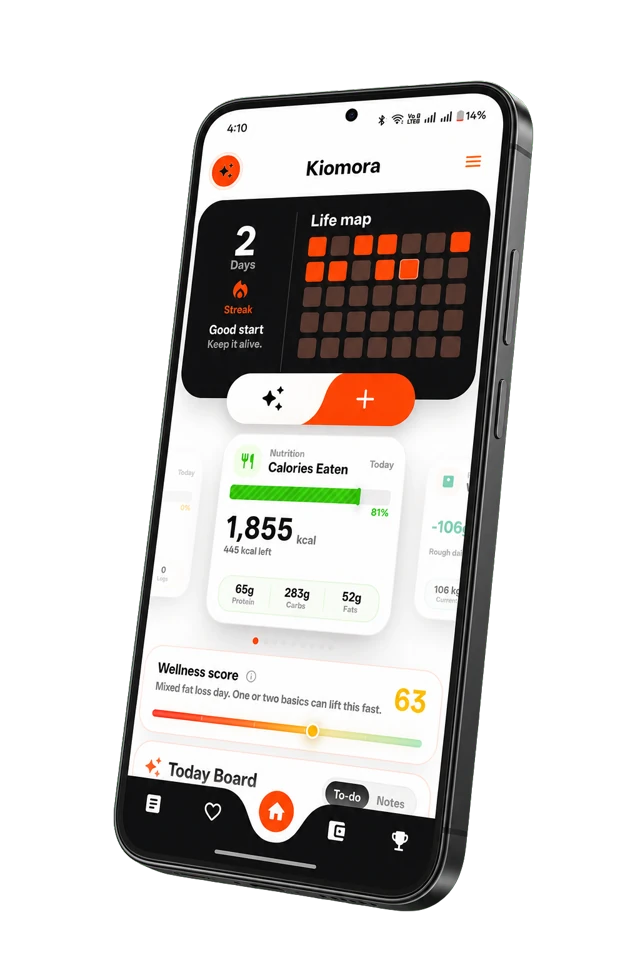
Kiomora for daily context
Your life, connected
Keep habits, wellness, spending, notes, and memories together so the details stay useful later.
Explore KiomoraDisclosure: We build Kiomora. This article explains the product problem we care about, while keeping the limits of personal data and generated interpretation explicit.
The understanding gap is the distance between collecting personal data and knowing what, if anything, to do with it. A watch can count steps. A journal can preserve a difficult day. A finance app can list transactions. None of those records automatically explains why a week felt better or what should change next.
Personal-informatics research has described tracking as a process that moves from preparation and collection through integration, reflection, and action. Barriers can appear at every stage. Later work on lived informatics also shows that lapsing and resuming are normal, not evidence that a person has failed.
Where the Gap Appears
| Record | What it can show | What is still missing |
|---|---|---|
| Wearable | Steps, heart rate, sleep estimates, workouts | Context, intent, and whether the measurement is accurate enough for the question |
| Journal | Events, feelings, decisions, narrative | Consistent structure and easy comparison across time |
| Habit tracker | Completion and consistency | Why a habit was easier, harder, useful, or no longer relevant |
| Dashboard | Totals, averages, and changes | Causation and the parts of life that were never measured |
More Data Is Not the Same as More Understanding
A chart can compress many observations into a useful view, but compression removes context. A sleep score may be useful for noticing a change while still being unable to explain it. A mood average can show direction while hiding the events behind the numbers.
The gap becomes larger when records sit in separate apps. Even if each tool works well, the person becomes the integration layer. They must remember which day mattered, open several timelines, align the dates, and decide whether an apparent relationship is meaningful.
AI Helps With Retrieval, Not Ground Truth
AI can reduce some of the mechanical work. It can structure a natural-language entry, retrieve related records, summarize a time period, or place several categories beside each other. That is useful scaffolding.
It can also produce a fluent explanation that goes beyond the evidence. NIST uses the term confabulation for confidently presented false or erroneous generative output. In a personal record, a generated claim should never quietly replace the entry it came from.
A trustworthy review keeps three layers separate
- Saved record: what the person entered, approved, or imported.
- Derived result: a transparent calculation such as a total, average, or count.
- Generated interpretation: a suggestion or summary that may be incomplete and must link back to its sources.
What Useful Understanding Looks Like
Useful personal analysis is modest. It recovers the right context, shows the dates and records involved, names missing information, and gives the person a better question to consider. It does not diagnose, predict with false confidence, or claim that a correlation explains a life.
For example, "You logged lower energy on four of the five days after late caffeine" is reviewable if the five entries are visible. "Caffeine causes your fatigue" is a causal claim the same record cannot establish.
A Practical Way to Close the Gap
- Choose one question. Avoid collecting a category without knowing how you will review it.
- Keep the record small. Capture the value plus one line of context.
- Review on a schedule. Weekly is often enough for routine questions.
- Return to the source. Inspect the original day before accepting a summary.
- Decide or stop. Change one action, continue observing, or stop tracking if the record adds no value.
Where Kiomora Fits
Kiomora addresses a narrow part of the gap. It keeps selected daily details in one reviewable record, lets users approve suggested logs, and provides Ask and reports for retrieval. It can help recover what was saved and place related context together. It should not claim to know an unrecorded cause or replace professional judgment.
This boundary matters. A useful personal tool does not need to understand a whole person. It needs to preserve the source, reduce search work, and be honest about what the available record cannot answer.
Frequently Asked Questions
Why do dashboards still feel confusing?
Dashboards show selected measurements. They often omit events, intentions, measurement uncertainty, and untracked context. Use them to notice changes, then inspect the underlying days.
Can AI close the understanding gap?
AI can help integrate, retrieve, and summarize records. It cannot guarantee causal understanding, fill in missing days, or make professional judgments safely.
Should I track more categories?
Only when the additional category helps answer a real question. More fields increase capture and review cost.
What is the simplest useful personal record?
A date, one value or event, and one sentence of context can be enough. The right minimum depends on the future question.
Sources
- Li, Dey, and Forlizzi: stage-based model of personal informatics
- Epstein and colleagues: lived informatics model
- Personal informatics analysis gap literature review
- NIST AI Risk Management Framework
- NIST Generative AI Profile
Common questions
Practical answers before you begin
- Why does tracking my habits not give me useful insights?
- A tracker can record what happened, but it cannot know the full context of your week. Useful reflection needs your interpretation, small experiments, and enough history to separate a one-off day from a repeatable pattern.
- Can AI tell me why I feel tired, anxious, or unproductive?
- No tool can reliably diagnose the cause of a feeling from a personal log. AI can help retrieve what you saved and organize questions to explore, but it should not replace professional care or your own context and judgment.
Don't forget to try Kiomora
See more thanone detail
Keep the useful parts of each day in one record you can return to.
Explore Kiomora