Evidence-based guide
What Is an AI Life Tracker? Benefits, Risks, Best Apps, and Future Trends
Learn what an AI life tracker does, where it helps, what risks to check, and how to choose a useful tool without overtracking.
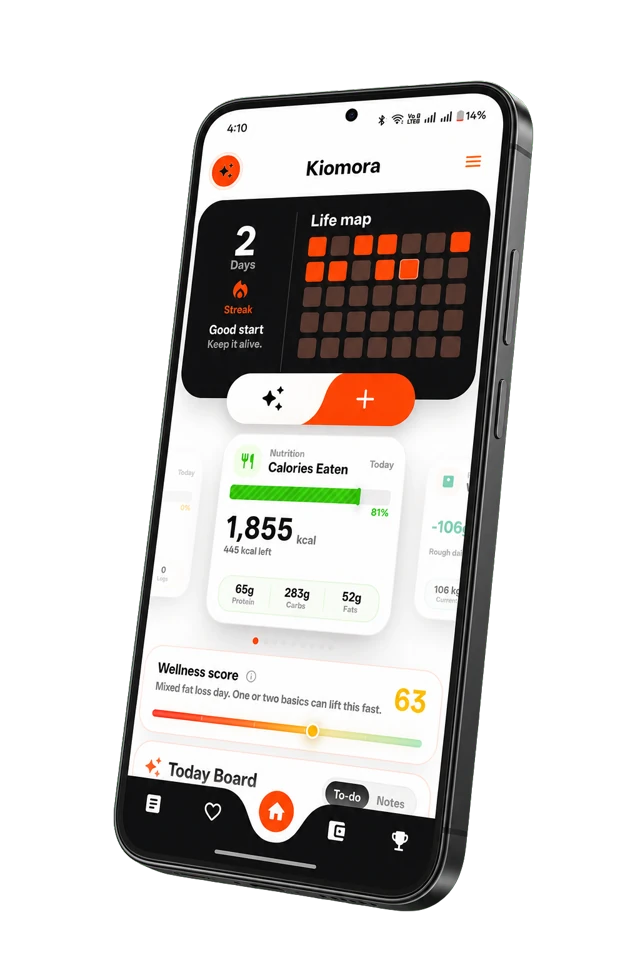
Kiomora for daily context
Your life, connected
Keep habits, wellness, spending, notes, and memories together so the details stay useful later.
Explore KiomoraDisclosure: We build Kiomora. It is included below. We also name situations where a journal, symptom tracker, statistical tool, or local-file system may be the better choice.
How this guide was checked: Research and product documentation were reviewed on July 13, 2026. "AI life tracker" is an emerging product category, not a clinical or academic standard.
An AI life tracker is a personal record that uses artificial intelligence to help capture, organize, or retrieve information across more than one part of daily life. Depending on the product, that may include notes, mood, sleep, habits, meals, movement, spending, symptoms, photos, or events.
The useful distinction is not whether an app has a chatbot. It is whether the app reduces work at one or more stages of personal tracking while keeping the source record visible and under the user's control.
What an AI Life Tracker Can Do
Personal-informatics research describes tracking as a process that includes preparation, collection, integration, reflection, and action. AI can help at several of those stages, but it does not remove the need for judgment.
| Capability | Useful behavior | Important limit |
|---|---|---|
| Natural capture | Accepts a sentence, voice update, or photo instead of several separate forms. | Transcription and extraction can be wrong. Important details need review. |
| Structuring | Suggests categories, values, dates, or units from an unstructured update. | The user should approve what becomes part of the saved record. |
| Retrieval | Finds entries by meaning or answers a question using saved records. | A good answer links back to the source entries instead of inventing certainty. |
| Review | Places related days, categories, or time periods together for inspection. | Association is not causation, diagnosis, or professional advice. |
How It Differs From Other Trackers
A habit tracker usually records whether a defined action happened. A journal preserves narrative and reflection. A quantified-self tool combines sensor or numeric data and may calculate statistical relationships. A symptom tracker is designed around health observations and reports. An AI life tracker can overlap with all four, but breadth does not automatically make it better.
Use a specialist tool when depth matters. A nutrition database is better for verified food composition. A symptom tracker is better for preparing a structured record for a clinician. A local Markdown system is better when direct file ownership is the priority. A combined life record is useful when the missing piece is the everyday context between those specialist records.
Where AI Actually Helps
One update can cover several parts of the day
A sentence such as "I slept poorly, skipped my walk, bought lunch, and felt flat after 3 PM" contains several possible records. An AI-assisted workflow can suggest sleep, activity, spending, food, mood, and note entries for review. This is useful only if correcting or deleting a suggestion remains easy.
Search can use meaning, not only exact words
Keyword search fails when the question and the original entry use different language. Semantic retrieval can connect "low energy" with entries that used words such as "sluggish" or "worn out." The result should still show dates and original entries so the user can check the match.
Review can start with the record instead of a generated story
Weekly and monthly summaries can reduce scrolling. The safest design distinguishes saved facts, calculations, and generated interpretation. NIST describes confident false output from generative systems as confabulation. For a personal archive, traceability matters because a fluent mistake can later feel like a real memory.
What AI Does Not Solve
- Consistency: Lower friction can help, but no interface guarantees a lasting routine. Research on lived informatics treats lapsing and resuming as normal parts of tracking.
- Causation: Two patterns moving together does not prove that one caused the other.
- Missing context: The system cannot retrieve what was never recorded and may not know why a value changed.
- Behavior change: Understanding a pattern does not perform the difficult action that follows.
- Professional judgment: A consumer life tracker is not a clinician, therapist, emergency service, accountant, or financial adviser.
The Main Risks
Private data becomes concentrated
A multi-domain record can reveal routines, locations, relationships, health concerns, and spending in one place. Before using a service, check authentication, encryption, model processing, deletion, export, account recovery, and what happens when a subscription ends.
Transcription and extraction errors become stored facts
Speech recognition quality varies across language, accent, dialect, background noise, and recording conditions. A 2020 PNAS study found substantial performance disparities across five commercial English speech-recognition systems. Products have changed since then, but the design lesson remains: test your own voice and review names, amounts, units, medications, and dates.
Tracking can become the project
If the system creates guilt, compulsive checking, or more administration than insight, reduce the scope. Track one useful question for two weeks, review it once, and keep only the fields that helped answer it.
How to Choose an AI Life Tracker
- Start with one question. Examples include "What was happening on my best-focus days?" or "Which expenses keep repeating?"
- Test capture on your own device. Log one realistic day with corrections, interruptions, and your normal language.
- Inspect the review step. Confirm that nothing important is silently saved without your approval.
- Ask a retrieval question. Check whether the answer includes the original dates and entries.
- Run a sample export or deletion. Do this before the archive becomes valuable.
- Check the privacy boundary. Understand whether data stays local, syncs to a provider, or is sent to another model service.
- Use a stop rule. If the routine has not produced a useful review after two to four weeks, simplify it or stop.
Which Type of App Fits Which Job?
| Need | Examples to evaluate | Why |
|---|---|---|
| Combined daily context | Kiomora | Natural text, voice, and photo updates can become reviewable logs across daily categories, followed by saved-log retrieval. |
| Symptoms and health factors | Bearable | Focused symptom, medication, mood, and factor tracking with reports and privacy documentation. |
| Statistical correlations | Exist | Combines connected and manual numeric data, then calculates correlations without a generative AI layer. |
| Traditional multimedia journal | Day One | Established writing, media, search, encryption, export, and optional reflective AI features. |
| Direct file ownership | Obsidian | Local Markdown files and a configurable plugin ecosystem, with more setup and plugin-trust decisions. |
| Low-friction mood check-ins | Daylio | Tap-based mood and activity capture without requiring an AI system. |
Kiomora is available on Android and iOS, with Monthly Reports and private agent setup also accessible on the web. Manual tracking, Ask Kiomora, weekly reports, and monthly reports are free. Kiomora Plus unlocks SuperLog, increased Ask usage, and private MCP connections. Those connections can retrieve supported records, but Kiomora does not yet provide a complete self-service account archive, so portability should still be part of the decision.
A Small Two-Week Test
Choose one question and no more than five fields. Capture one short update per day. At the end of each week, ask the same question and inspect the source entries. Remove any field that did not help. Continue only if the record changed a decision, recovered a useful detail, or made a pattern easier to inspect.
This test is intentionally small. The goal is not to build a digital copy of your life. It is to learn whether a particular record gives you enough value to justify the time and privacy cost.
Frequently Asked Questions
Does an AI life tracker track everything automatically?
No. Capabilities vary widely, and passive collection creates its own privacy and accuracy costs. Prefer explicit permissions and clear review controls.
Can it find patterns in my life?
It can place related entries or values together and may calculate associations. Treat those results as questions to investigate, not causal conclusions.
Is an AI life tracker private?
There is no category-wide answer. Compare local storage, cloud storage, encryption scope, model providers, retention, deletion, export, and recovery for the exact app and feature you plan to use.
Is a habit tracker an AI life tracker?
Not usually. A habit tracker records defined actions. An AI life tracker generally accepts broader context and helps structure or retrieve it across categories. A product can include both workflows.
What is the best free AI life tracker?
The right starting point depends on the job. Kiomora offers free manual tracking, Ask, and reports. Apple Journal is a no-cost journal on supported Apple devices. Obsidian is free for personal local-file use. Daylio has a free mood-tracking option. Test the workflow before deciding by price alone.
Research and Product Sources
- Li, Dey, and Forlizzi: stage-based model of personal informatics
- Epstein and colleagues: lived informatics, lapsing, and resuming
- Fogg Behavior Model
- NIST AI Risk Management Framework
- NIST Generative AI Profile: confabulation and privacy risk
- Koenecke and colleagues: disparities in automated speech recognition
- Bearable privacy and data-handling documentation
- Exist features, integrations, platforms, and pricing
- Exist privacy, export, deletion, and no-AI position
- Day One plans, encryption, AI features, and export
- Obsidian pricing and sync options
- Daylio product overview
Common questions
Practical answers before you begin
- What does an AI life tracker actually track?
- It depends on the app. Some focus on a journal, others on wellness, habits, expenses, or a mix. Check what you can save, what needs your approval, where the data lives, and whether the app can retrieve the entries you chose to keep.
- Are AI life trackers private?
- Privacy varies widely. Read the app privacy policy, understand whether it uses cloud processing, and avoid treating any personal tool as a substitute for a clinician, therapist, or financial adviser.
Don't forget to try Kiomora
See more thanone detail
Keep the useful parts of each day in one record you can return to.
Explore Kiomora