Evidence-based guide
Voice Journaling: How to Start and Choose an App
Learn how voice-first journaling works, how it differs from voice memos, which app and privacy features matter, and how to start in two minutes.
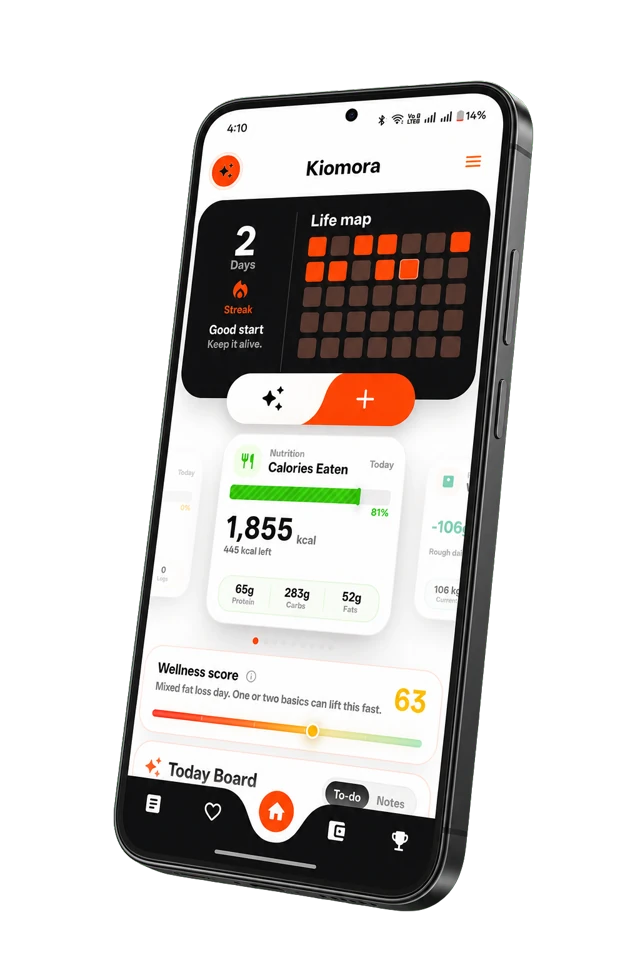
Kiomora for quick capture
Speak it. Keep it.
Capture a natural update, review the details, and keep what matters with the rest of your day.
Explore KiomoraJournaling often fails for an ordinary reason: the routine asks for more time and attention than a person can give on a difficult day. A missed entry then feels like a broken streak instead of a normal gap.
The problem may be motivation, privacy, time, physical comfort, or the blank page itself. Voice does not solve all of those problems, but it gives people another capture method when typing or handwriting feels inconvenient.
Voice journaling replaces a keyboard or notebook with spoken capture. This guide separates research on expressive writing and affect labeling from claims about voice journaling itself, explains the drawbacks of transcription, and shows how to choose a useful voice journal app. Voice can also be one input inside a broader AI life tracker.
1. The Friction of Traditional Journaling
To understand why voice journaling is effective, we must first look at why people quit traditional journaling. Behavioral scientist BJ Fogg developed a model stating that behavior occurs when motivation, ability, and a prompt converge simultaneously. When motivation is low (such as being tired at night), the ability required to perform the task must be extremely easy.
Speaking can capture more words in a short interval than handwriting for many people, but speed is not automatically better. Writing can support deliberate editing and structure. Voice is most useful when the obstacle is getting an honest first draft out of your head.
Writing requires visual focus and manual input. Voice can be useful during a quiet walk, while sitting somewhere private, or as a short check-in before bed. Do not record while driving, crossing roads, cooking with heat or knives, or doing anything that needs your full attention.
2. The Handwriting Purism and Digital Guilt
A paper notebook has real advantages: it is tactile, private by default, free from notifications, and easy to revisit. Digital and voice formats have different advantages. The useful question is not which medium is more authentic, but which one fits the moment and the kind of thinking you want to do.
A person can also mix formats. A brief voice entry can capture what happened, while a notebook can hold slower reflection. Missing a day does not invalidate either record.
The goal is a record that helps you think or remember, not a perfect streak or a beautiful artifact. Choose voice when speaking lowers the barrier, and choose writing when the slower pace improves the thought.
3. Voice Memo vs. Voice Journal vs. AI Voice Journal
As people look for alternatives to handwriting, they often conflate three different practices. Understanding the distinction helps when choosing a tool.
The Voice Memo
A voice memo is a utilitarian recording. You use the default app on your smartphone to record a grocery list, a fleeting idea, or a reminder. It is a simple audio file. The primary problem with a voice memo is that it has zero intentionality and extremely limited retrieval. If you record a ten-minute emotional breakdown on a Tuesday, it becomes "Audio Recording 42." You will likely never listen to it again. It serves a purpose for quick, immediate capture, but it is not a journal.
The Voice Journal
A voice journal implies intentional reflection. You are not just capturing a reminder; you are intentionally taking time to process your emotions, document your personal growth, and explore your mental state. A traditional voice journal app might organize these recordings by date, allow you to attach photos, and provide a dedicated space separate from your grocery lists. However, if the app only saves audio, you still face the "black hole" problem: finding a specific thought from six months ago requires scrubbing through hours of audio.
The AI Voice Journal
A searchable voice journal combines intentional reflection with transcription and retrieval. Recording quality, accents, background noise, and product design all affect transcription accuracy. When the transcript is searchable and linked to the original entry, it becomes easier to revisit a thought without scrubbing through hours of audio.
4. The Science: Expressive Writing and Affect Labeling
Two research areas are relevant here, but neither proves that every voice-journaling routine produces a therapeutic benefit: expressive writing and affect labeling.
The Expressive Writing Paradigm
Early expressive-writing experiments asked participants to write about stressful or traumatic experiences under controlled conditions. Later studies examined a wide range of physical and psychological outcomes. Those studies concern writing, specific prompts, and specific populations. They should not be converted into a promise that talking to a phone will improve health.
Joanne Frattaroli's 2006 meta-analysis reviewed 146 experimental-disclosure studies and reported a small overall effect, with results varying across outcomes and study conditions. It is useful evidence for careful wording, not a reason to advertise voice journaling as treatment.
Affect Labeling: Why Speaking Works
Pennebaker's work focused on writing, so it should not be treated as direct proof that spoken journaling produces the same outcomes. Research on affect labeling explores how putting feelings into words may relate to emotional processing, but individual results and study conditions vary.
Lieberman and colleagues used an fMRI labeling task involving emotional faces. During affect labeling, the study reported greater right ventrolateral prefrontal activity and reduced amygdala response compared with an affect-matching condition. That laboratory task is narrower than keeping a voice journal.
The result supports the idea that putting an emotion into words can change how it is processed. It does not mean that naming a feeling always produces immediate relief or that one brain region acts as a simple on-off brake.
In a 2012 exposure study, Kircanski, Lieberman, and Craske asked spider-fearful participants to use affect labeling, reappraisal, distraction, or exposure alone. The affect-labeling group showed a lower skin-conductance response during a later test. This was a controlled exposure study, not a general comparison of spoken and written journals.
The practical takeaway is modest: naming a feeling may be useful for some people in some contexts. It is not guaranteed to reduce distress, and a journal should not replace professional help when distress is urgent, persistent, or unsafe.
5. The Neuroscience of Speaking
Almost everyone has experienced this phenomenon: you have a complex problem at work, or an argument you are trying to untangle in your head. The thoughts feel like a dense, chaotic cloud. You finally sit down with a friend to explain the issue, and halfway through describing it, you suddenly stop. "Never mind," you say. "I just figured it out."
Your friend may not have offered advice. Explaining the problem forced you to choose an order, name the missing information, and hear where your own explanation stopped making sense.
Speaking can turn several simultaneous thoughts into a sequence. That constraint may make a complicated experience easier to inspect, although some people think more clearly by writing, drawing, or sitting quietly first.
Speech relies on distributed language, motor, and auditory systems. Reducing that process to one brain area creates a neat story but not an accurate explanation of why a personal voice entry may feel useful.
The clearest practical difference is auditory feedback: you can hear the words as you form them. That can expose repetition, uncertainty, or a missing step. It does not make the speaker objective, but it provides another way to review the thought.
Speaking can make a complicated thought easier to externalize, especially when typing feels slow or inconvenient. That experience varies by person and setting. A searchable transcript can help with later review, provided the transcript remains linked to the original recording and is checked for errors.
6. Why Audio Journals Failed Historically (And What Changed)
Voice journaling remained less practical when recording, transcription, storage, and search required more work. Modern tools reduce some of that friction, but voice is not automatically better than writing. Privacy, transcription quality, safety, and personal preference still matter.
The Era of Microcassettes and Early Digital Recorders
In the 1980s and 90s, recording a voice diary required a dedicated Dictaphone or microcassette recorder. While capturing the audio was easy, retrieving the information was a nightmare. Audio is inherently linear. If you wanted to find a specific thought about a career decision you made three weeks ago, you had to manually rewind and fast-forward through hours of tape. Audio became a black hole of information - easy to put things into, nearly impossible to get things out of.
The Smartphone Era and the Illusion of Convenience
Smartphones made audio capture widely available, but a folder of recordings with generic filenames is still difficult to review. Dates, titles, transcripts, and links back to the original audio make a voice archive more usable.
The Speech-to-Text Change
Speech-to-text models improved considerably between 2020 and 2023, including the release of OpenAI's Whisper. Many recordings became searchable, though accuracy still varies with speech, language, background noise, and recording quality. Important names, amounts, and personal details should always be checked against the audio.
Accuracy is also not distributed equally. A 2020 PNAS study found substantial error-rate differences between Black and white speakers across five commercial English-language speech-recognition systems. The products and models have changed since that study, but it remains a strong reason to test an app with your own accent, dialect, language, and recording environment.
The Semantic Search Inflection Point
Semantic search can retrieve entries using related concepts instead of exact keywords. That can help when you remember the idea but not the wording. It can also return irrelevant matches, so a useful result should show the source entry and date rather than presenting a generated answer alone.
Transcription and semantic retrieval reduce an old barrier, but they do not erase it. A trustworthy voice journal still needs accurate dates, editable transcripts, clear source links, privacy controls, and a simple way to delete or export the record.
7. When Voice Journaling is Worse Than Writing
Despite the technological leaps and psychological benefits, voice journaling is not a universal replacement for writing. It has distinct limitations that must be acknowledged.
- Linear Thinking vs. Structured Thinking: Writing forces a slower, more deliberate pace. This constraint is beneficial when you need to structure a complex argument, solve a multi-step problem, or plan a project. Speaking fast can lead to rambling loops without resolution.
- Verbal Overshadowing: Describing something in words can sometimes impair your later recognition memory for the original experience. Over-relying on spoken transcription may alter your memory of an event, substituting the true memory with the narrative you constructed aloud.
- Privacy and Social Friction: You can write discretely in a crowded room. You cannot discretely speak your private feelings. Voice journaling requires physical privacy, making it impossible in shared offices or quiet household environments.
- Data Privacy Concerns: Voice recordings are personal data and can reveal identity, health, location, relationships, and background context. Voice becomes biometric data under some laws when technical processing is used for unique identification or authentication. Storing audio and transcripts with a cloud provider creates a different privacy boundary from keeping a notebook locally.
8. Best Voice Journal Apps in 2026
Choosing the right tool is critical for ensuring your spoken entries are actually useful later. However, before looking at specific apps, you must understand how to evaluate them.
How to Evaluate a Voice Journal App
Do not simply choose the most popular app. Look specifically at these core criteria:
- Transcription Quality: Test a real sample with your language, accent, speaking pace, names, and normal recording environment. A model name alone does not guarantee accuracy for your voice.
- Search and Retrieval Capabilities: Does it only offer basic keyword search, or does it utilize semantic search, allowing you to query concepts and themes?
- Privacy and Data Ownership: Are your audio files processed on your device, or are they sent to a cloud server? Are they used to train third-party AI models? Look for explicit privacy guarantees or end-to-end encryption.
- Raw Audio Preservation: Does the app keep the original audio file, or does it only save the text transcript? Keeping the audio is vital for preserving the emotional tone (prosody, pauses, laughter) that text simply cannot convey.
Kiomora
Kiomora supports voice alongside text and photo input to reduce logging friction. It can turn what you say into reviewable structured logs for categories such as water, sleep, food, activity, or expenses. Review important entries before saving them. Ask Kiomora then helps you retrieve what you saved later.
Best For: Users who want to combine free-form emotional journaling with quantitative life logging easily.
Day One
Day One is an established traditional journal. Its Silver and Gold plans document audio recording and transcription alongside text, photos, video, location, search, and export. Day One documents end-to-end encryption on all current plans.
Best For: People who want a polished multimedia journal and are comfortable paying for audio recording and transcription.
Apple Journal
Apple Journal can record audio and, in supported English locales, show a transcript that can be added to an entry. Apple also documents search, filters, device locks, iCloud sync controls, and export. Check the current device, locale, and account requirements before relying on transcription or a particular privacy setting.
Best For: People on supported Apple devices who want a built-in journal with audio, search, prompts, and no separate subscription.
Reflect
Reflect is a networked-thought application favored by founders and researchers. It features excellent voice note transcription and allows you to easily link concepts together using bi-directional links.
Best For: Professionals who want to use voice to capture ideas and integrate personal reflection into their broader knowledge management system.
Journey
Journey provides a timeline-based journal across Android, iOS, Mac, Windows, Linux, and web. It documents audio attachments and recording on supported paid platform licenses, while membership adds cross-platform access and cloud features.
Best For: Users who need a traditional journaling interface but constantly switch between different operating systems.
9. How to Start Voice Journaling
If you have never spoken to a device before, the first few attempts may feel performative and awkward. You might feel self-conscious or worry about stuttering. That discomfort often eases once the recording stops feeling like a performance.
The best way to begin is to choose a private, stationary moment when recording will not divide your attention. Sit somewhere quiet, take a short walk away from traffic, or record before you start another task. Do not voice-journal while driving.
Do not aim for a twenty-minute deep dive on day one. Set a timer for 60 seconds. Treat it exactly as you would a voice note to a trusted friend. If you do not know where to start, simply state what you are currently looking at, and then describe the most prominent source of stress or excitement in your day. Let the transcription handle the stuttering and pauses.
10. Frequently Asked Questions
Is voice journaling as effective as written journaling?
Research on expressive writing does not prove that voice journaling has identical effects. Voice may be easier for some people to maintain, while writing may support slower structure and editing. Choose by the purpose of the entry and how the method affects you.
Does speaking my feelings out loud really help?
Some controlled research has examined how labeling emotions relates to emotional and physiological responses. Those findings should not be generalized into a guaranteed benefit from voice journaling, especially outside the studied conditions.
What happens to my tone and emotion in the transcription?
Transcripts flatten pauses, laughter, emphasis, and other vocal detail. If that texture matters to your purpose, choose an app that clearly documents audio retention and playback. If search and quick review matter more, a checked transcript may be enough. Understand the privacy cost before retaining sensitive audio.
Is voice journaling private?
Audio files require careful privacy considerations. Always review the privacy policy of the app you choose. Ensure you understand whether your audio is processed on-device or sent to the cloud, and whether it is used to train AI models.
11. Research and Product Sources
These sources were checked on July 28, 2026. Research on expressive writing and affect labeling is included for context, not as proof that a consumer voice journal provides treatment or a guaranteed health benefit.
- BJ Fogg's Behavior Model: motivation, ability, and prompts
- Frattaroli: meta-analysis of 146 experimental-disclosure studies
- Kircanski, Lieberman, and Craske: affect labeling during exposure
- Affect labeling and reappraisal in healthy adults
- Koenecke and colleagues: disparities in automated speech recognition
- OpenAI Whisper research overview
- Day One plans, audio transcription, encryption, and export
- Apple Journal audio recording and transcription
- Apple Journal search and filters
- Journey membership and cross-platform features
- Dutch data protection authority: when voice processing becomes biometric identification
12. Conclusion
Voice journaling is an alternative capture method, not a replacement for structured writing or professional support. Its main advantage is practical: some people find it easier to speak in moments when they would not type. Transcription can make those recordings searchable, but the text should be reviewed for errors.
Common questions
Practical answers before you begin
- How do I start voice journaling?
- Start with a two-minute prompt: what happened, what stood out, and what you want to remember. You do not need a polished recording; the goal is a useful record you will actually revisit.
- Can voice journal entries be searched later?
- They can when an app stores a transcript or searchable record. Check transcription quality with your own voice and language, and understand the app privacy policy before recording personal material.
- What is the difference between a voice memo and a voice journal?
- A voice memo is usually an isolated recording. A voice journal adds a repeatable reflection practice and may include dates, transcription, correction, search, prompts, or links to the rest of your daily record.
- What should I say in a voice journal?
- Use three simple prompts: what happened, how it felt, and what you want to remember or do next. A useful entry can be sixty seconds long.
Don't forget to try Kiomora
See more thanone detail
Keep the useful parts of each day in one record you can return to.
Explore Kiomora